“Any child detained is evidence of failed systems, but that failure is then compounded further. Justice systems meant to protect and support children often add to their suffering.”
– Henrietta Fore, former Executive Director of the United Nations Children’s Fund (UNICEF)
Co-funded by the European Union. However, the views and opinions expressed are solely those of the authors and do not necessarily reflect the views of the European Union. Neither the European Union nor the granting authority can be held responsible for them.
BRIDGE Project
BRIDGE Project
Project Overview
BRIDGE is a one-year Erasmus+ project dedicated to reimagining youth detention by developing small-scale, community-integrated detention houses for young adults aged 18–25. Led by a European partnership between Restorative Justice Netherlands, RESCALED, and supported by VWZ De Huizen, BRIDGE aims to transform current justice responses into more human-centred, development-oriented alternatives. The project explores innovative detention models that emphasise education, personal growth, and social integration, while producing evidence-based policy recommendations and practical tools for professionals. Through study visits, workshops, and cross-sector collaboration, BRIDGE seeks to promote a justice system in which young adults are supported to build better futures. The ultimate goal is to provide a comprehensive blueprint for implementing small-scale youth detention houses – offering safer environments, stronger rehabilitation pathways, and meaningful community connections.
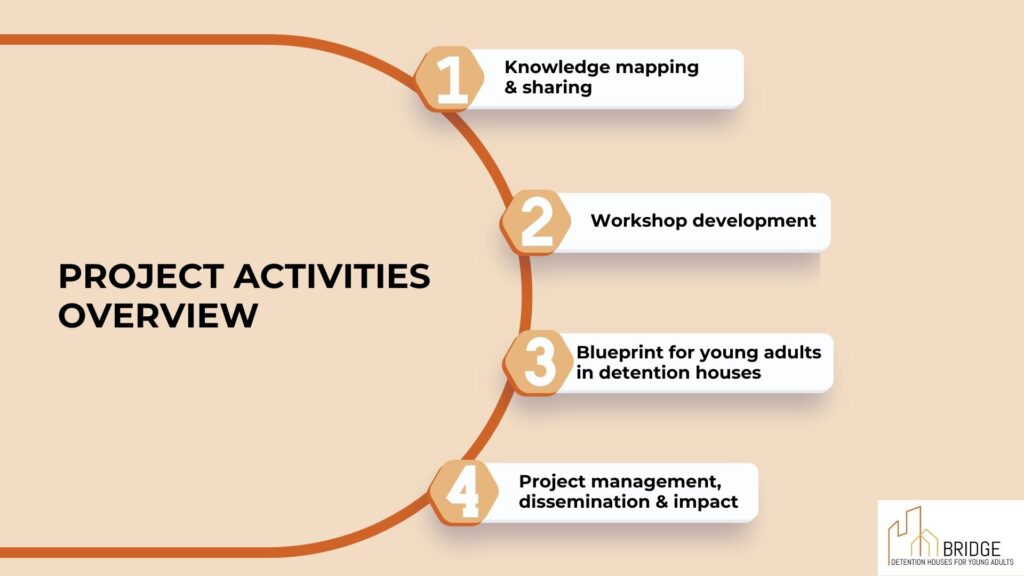
Activity 1 focuses on collecting, organising and synthesising existing knowledge on youth detention across six European countries. The aim is to develop a solid understanding of current legal frameworks, practices and reform initiatives in order to identify common patterns, gaps and opportunities for the development of small-scale, community-integrated detention houses for young adults..
The activity begins with an analysis of national legislation and policy frameworks related to youth detention. This includes examining how young people are referred into different forms of custody (judicial decision or correctional/administrative decision), age thresholds, the relationship between youth justice, welfare and forensic services, as well as existing models comparable to “secure care.” Relevant studies, evaluations and international initiatives are also reviewed to ensure a comprehensive overview of current knowledge.
Building on this desk research, an online survey is conducted with practitioners, organisations and stakeholders involved in youth justice and youth detention. The survey gathers practical insights, perceived needs, experiences with existing systems and expectations regarding future small-scale detention models.
Preliminary findings from the research and survey are then presented in two one-hour webinars. These sessions offer space for discussion, reflection and critical feedback from a diverse group of stakeholders across Europe, helping refine and contextualise the results.
Finally, all insights from Activity 1 are consolidated into a conceptual framework that will guide the subsequent project workshops as well as the development of policy recommendations. This framework will also inform a practical toolkit designed to support policymakers and practitioners in taking concrete steps towards implementing small-scale, community-based youth detention houses.
Activity 2: Workshop Development
Activity 2 aims to facilitate a structured exchange of knowledge, experiences, and best practices related to small-scale, community-integrated youth detention models. A central component of this activity is a series of study visits to three European countries where small-scale detention facilities are already in place. These visits allow professionals to gain firsthand insight into everyday practices, observe how such facilities operate, and reflect on which elements could be adapted to their own national contexts. The practical learning gained during these visits forms an essential foundation for the subsequent stages of the activity.
Building on these experiences, knowledge-sharing workshops bring together practitioners, policymakers, and individuals with lived experience. The purpose of these workshops is to discuss observations from the study visits, identify key challenges, and highlight inspiring practices. By combining different perspectives, the workshops help develop a deeper shared understanding of the pedagogical, organisational, and structural conditions required for successful small-scale detention houses.
Following the workshops, policy recommendation sessions are held to translate the gathered insights into concrete, actionable guidance. These sessions focus on identifying the legal, organisational, and financial prerequisites necessary for implementing small-scale detention models. The resulting recommendations are intended to support policymakers and professionals responsible for shaping the future of youth detention systems.
Together, these interconnected steps create the basis for a comprehensive best-practice report, strengthen cross-border collaboration, and provide clear direction for future reform. Activity 2 therefore plays a key role in deepening the collective understanding of how community-integrated youth detention houses can function and what is required to successfully implement them across different national contexts.
Activity 3 – Blueprint Development
Activity 3 focuses on developing a structured and practical blueprint that outlines how youth detention systems can transition towards small-scale, community-integrated models. Building on the knowledge gathered in the earlier stages of the project, this activity brings together legal analysis, policy insights and practical implementation guidance to create a clear roadmap for reform.
A core component of this activity is the examination of legal and policy frameworks from several European countries to identify the regulatory conditions, obstacles and enabling factors relevant to establishing small-scale detention houses. This comparative perspective helps clarify what is required to adapt existing systems or design new models that align with international standards and youth-specific needs.
In addition, the activity outlines the key steps necessary for system transformation. These include considerations around facility design, staffing structures, community integration strategies and programme development — all essential elements for creating safe, developmental and sustainable detention environments for young people.
To ensure accessibility and practical value, the findings will be translated into visual infographics that summarise the most important insights in a clear and user-friendly way.
Activity 4 focuses on ensuring that the knowledge, tools and recommendations developed throughout the project reach the people who can use them. This includes organising online learning sessions, creating visual materials such as infographics, publishing blog posts, translating key documents and hosting small conferences to share the project’s findings more widely. In addition, this activity coordinates the project’s overall management and supports all partners in engaging national and international stakeholders.
The aim is to strengthen awareness of youth detention reform, promote evidence-based policy recommendations and ensure that the project’s results continue to have an impact beyond its duration through sustained collaboration and integration into existing knowledge platforms.